



A question bank is written for every nursing student at once. Your lecture slides and notes are what your own program taught you. Jungle turns them into practice questions (multiple choice to check what you remember, case questions to apply it) and brings back the ones you miss until you know them. This page shows how to set that up, and how the NCLEX itself works, from NCSBN's official documents.
How to practice NCLEX questions from your notes
1. Upload your nursing course material
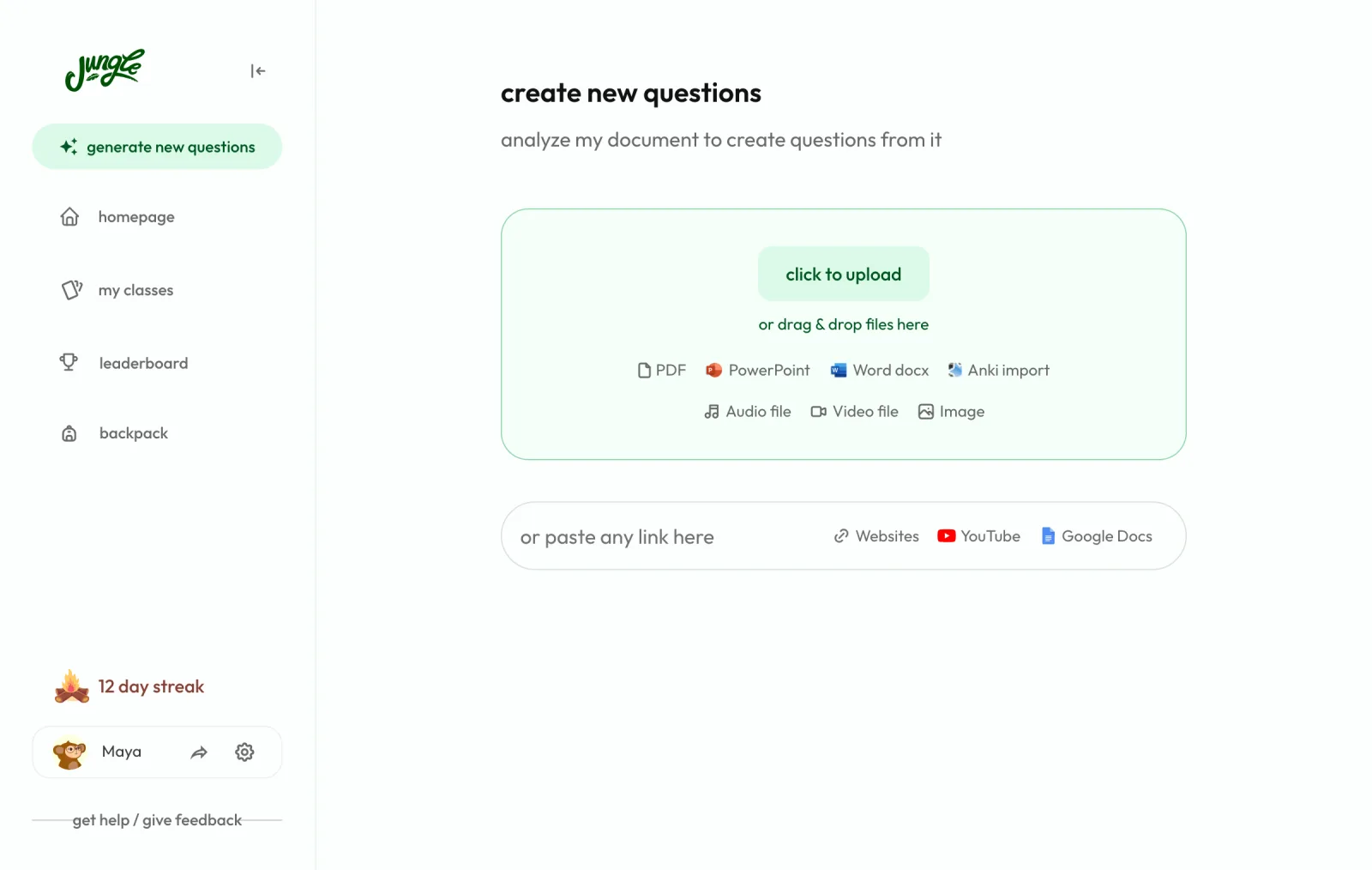
Upload your lecture slides (PowerPoint or PDF), your notes as a Word file or photos, a recorded lecture as an audio or video file, or paste a link to a YouTube video, a web page or a Google Doc. Jungle reads it, so every question comes from what your program taught.
2. Choose your questions
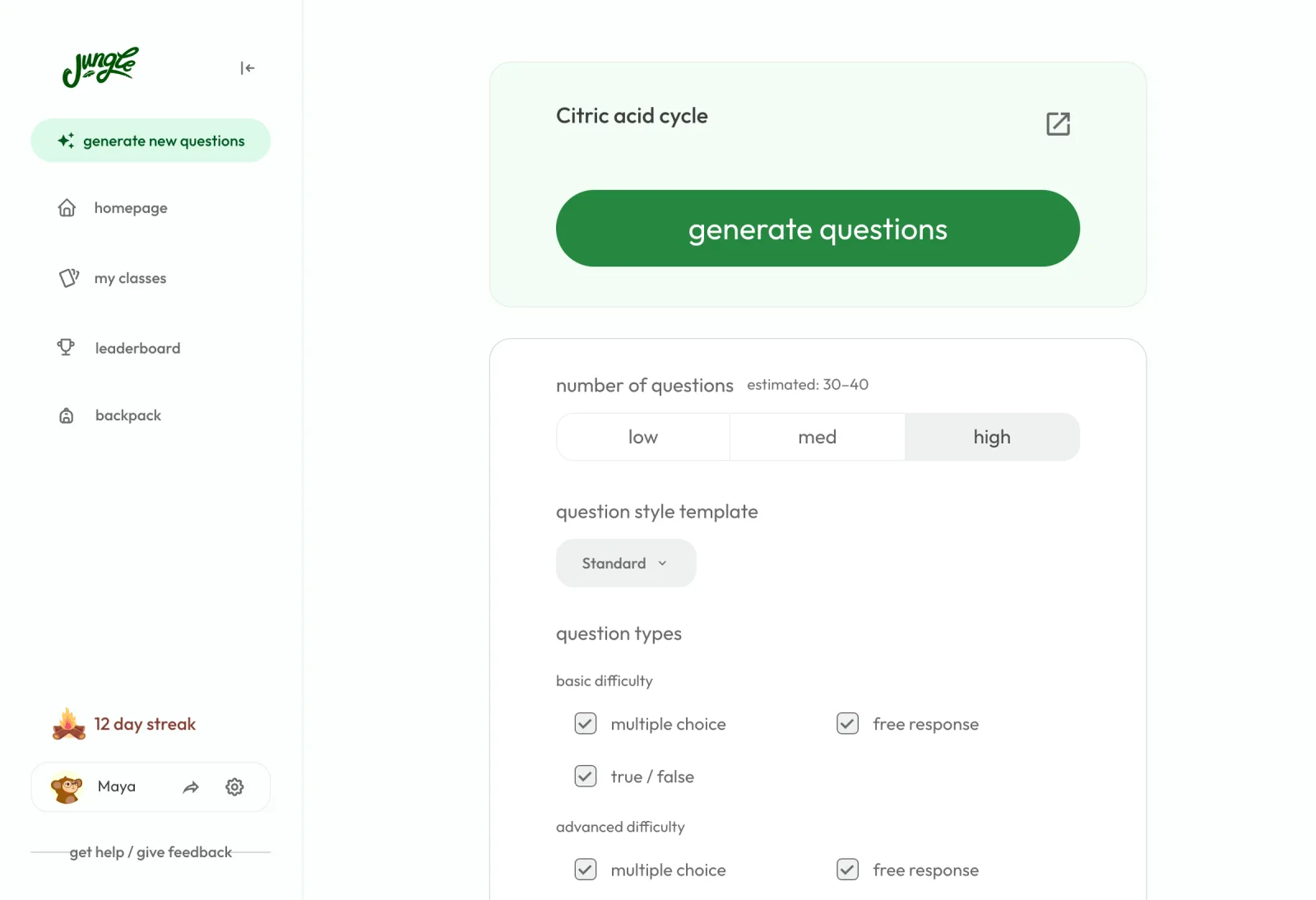
Pick the question types: multiple choice and true / false for quick recall, free response to explain an idea in your own words, and case questions, which put what you learned into a short scenario and ask you to apply it. Choose basic or advanced difficulty (case questions are part of advanced), how many questions you want (low, medium or high, with an estimate before you start) and the language of the questions.
3. Answer, then ask why
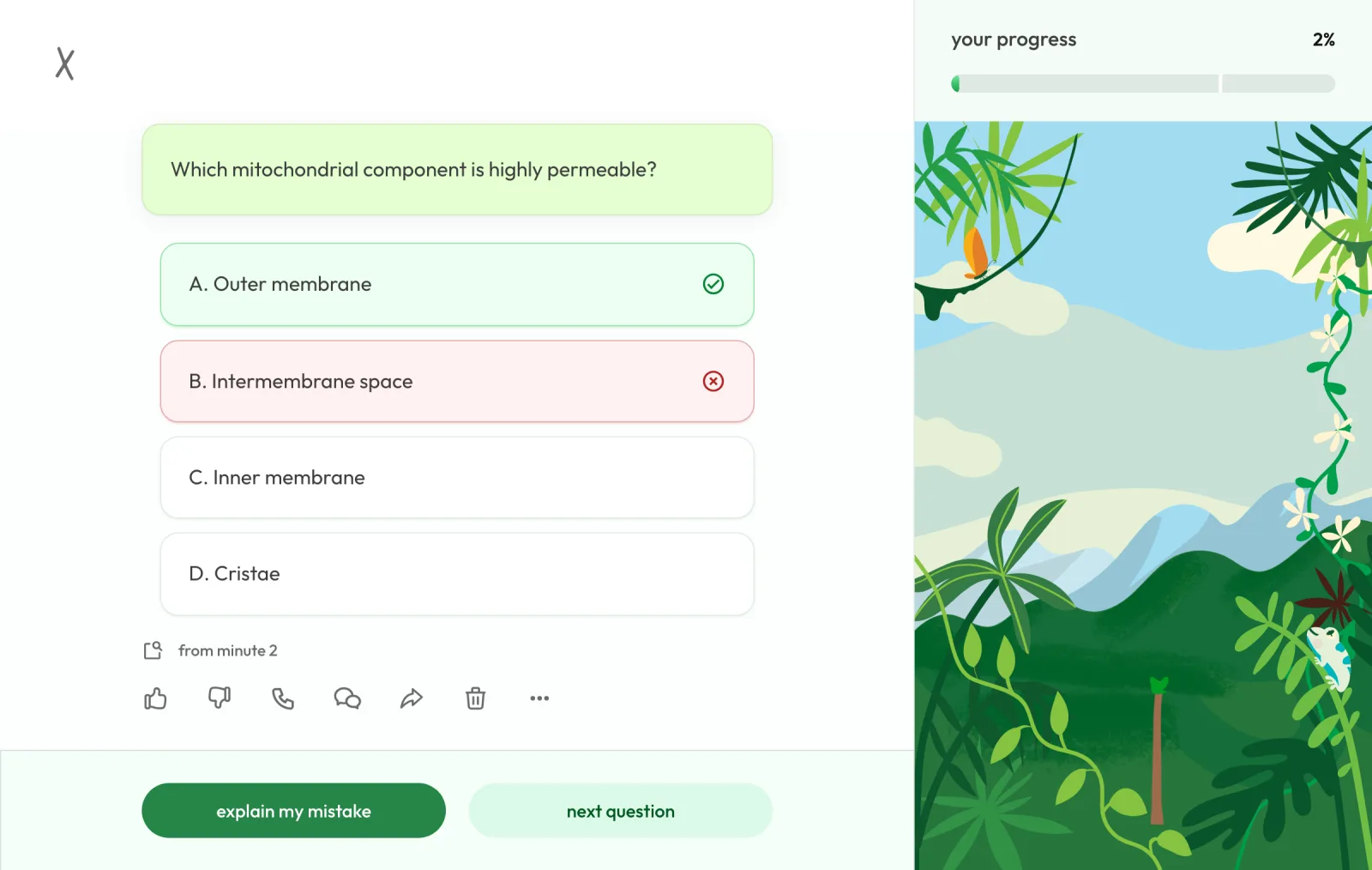
Jungle shows right away whether each answer is right. Ask it to explain any answer, including why the choice you picked is wrong. The free plan includes a limited number of explanations each hour; paid plans have no limit. If a question doesn't match your notes, edit or delete it, or add your own.
4. Review what you missed every day
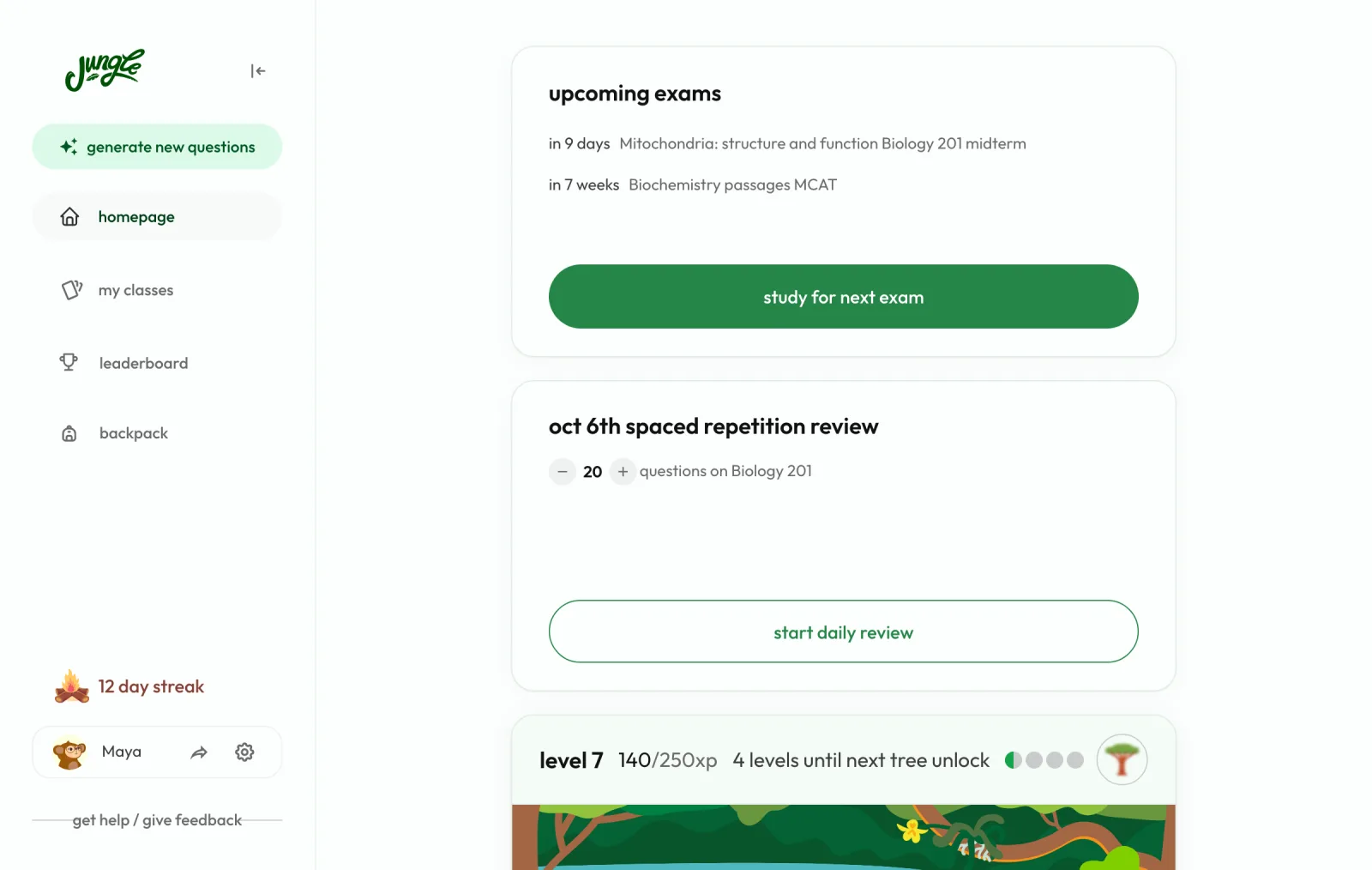
The questions you miss come back in your daily review (spaced repetition) until you get them right, so earlier courses keep coming back instead of fading before the NCLEX. To sit a longer mock exam across several lectures, use the practice exam generator.
How the NCLEX works
NCSBN (the National Council of State Boards of Nursing) develops the NCLEX. These facts come from its 2026 candidate bulletin, the 2026 NCLEX-RN test plan and the 2026 NCLEX-PN test plan. Check nclex.com for changes before your exam.
- NCLEX-RN: for candidates for registered nurse licensure. US boards of nursing and most Canadian nursing regulators use it.
- NCLEX-PN: for candidates for practical / vocational nurse (LPN/VN) licensure, in the US only.
- Both: 85 to 150 items, a five-hour limit that includes breaks, 15 unscored pretest items, and three case studies (18 items) plus about 10% stand-alone clinical judgment items.
Who runs it. NCSBN develops the exam, and nursing regulatory bodies use the result to make licensure decisions. Only they release official results. You register with Pearson, the testing vendor (see the NCLEX FAQs), and take the exam on a computer at a Pearson test center.
It adapts to you. The NCLEX is a computerized adaptive test. Each time you answer, the computer re-estimates your ability and picks the next item to match it, so expect every item to feel challenging. The exam stops when the computer is 95% certain your ability is clearly above or below the passing standard, when you reach the maximum number of items, or when time runs out. NCSBN explains the rules on its computerized adaptive testing page. The number of items you get is not a sign of whether you passed.
Time and breaks. The five hours include the introduction and all breaks. Two optional breaks are offered, after about two hours and after about three and a half hours of testing. If you get all 150 items, that leaves a little under two minutes per item once breaks are counted. Once you confirm an answer and move on, you can't go back to it.
Next Generation NCLEX. Since the Next Generation NCLEX launched on April 1, 2023, the exam measures clinical judgment directly, in case studies and stand-alone items. A case study is a set of six items about the same client, with information that unfolds as you go. Each of the six items measures one step of NCSBN's clinical judgment model: recognize cues, analyze cues, prioritize hypotheses, generate solutions, take action and evaluate outcomes.
Item formats. NCLEX items come in several formats. Some have one correct answer and others ask you to select all that apply; any item can include charts, tables or graphics, and some show a client chart with tabs to read. Items with more than one correct answer are scored with partial credit. NCSBN's tutorial and sample pack show the item types, so try them before exam day.
Content. The test plans group the exam into four Client Needs categories: Safe and Effective Care Environment, Health Promotion and Maintenance, Psychosocial Integrity and Physiological Integrity. Each plan lists the subcategories and the share of items for each, which makes it a good checklist for sorting your notes.
Why practice with questions from your own notes
You cover each course as you take it. Upload every lecture as it is taught and you reach NCLEX review with practice on everything your program covered, not only what you crammed at the end.
The wrong answers sound right. In a blind comparison of five AI study tools, Jungle's questions scored highest for believable wrong answer choices (69, against 56 for the next tool). A question you can't pass by ruling out silly options is the kind worth practicing. Here is more on the multiple choice question maker.
You practice applying, not just recalling. Case questions put what you learned into a scenario and ask what it means there, which is closer to the NCLEX's clinical judgment items than a definition card is.
You can study the way that suits the topic. Turn a long reading into notes with a chat beside them, where you can ask for a simpler version, an analogy or a mnemonic. Quiz yourself on labeled diagrams with image occlusion. Talk a topic through out loud with monkey, Jungle's voice tutor. Jungle works on the web and in the iPhone and Android apps.
What Jungle doesn't do
- It has no NCLEX question bank and no NCLEX question style. Jungle's exam-style templates are for USMLE Step 1 and the MCAT. For the NCLEX, every question comes from the material you upload.
- It doesn't copy NGN case studies or item formats. Practice those with NCSBN's tutorial and sample pack.
- It writes from your material, so check it. Like any AI, it can get things wrong. If a question surprises you, compare it with your notes, ask for an explanation, and edit or delete it if it's off. Your program and NCSBN's materials are the authority.
Frequently asked questions
Does Jungle have an NCLEX question bank?
No. Jungle writes practice questions from the nursing material you upload, so they cover your own courses. Use them alongside NCSBN's tutorial and sample pack and any NCLEX review your program recommends.
Can Jungle write questions like the NGN case studies?
Jungle's case questions put what you learned into a short scenario and ask you to apply it, as multiple choice or free response. They are not six-item NGN case studies, so practice that format with NCSBN's sample pack as well.
How many questions are on the NCLEX?
Both the NCLEX-RN and the NCLEX-PN have between 85 and 150 items, with a five-hour limit that includes breaks. Every exam includes 15 unscored pretest items, and because the test adapts to you, the number of items you get doesn't tell you whether you passed.
What's the difference between the NCLEX-RN and the NCLEX-PN?
The NCLEX-RN is the licensure exam for registered nurses, and the NCLEX-PN is for licensed practical or vocational nurses. Both are adaptive, 85 to 150 items and five hours, and each has its own test plan with its own subcategories and percentages.
Can I practice NCLEX questions for free?
Yes. Jungle's free plan includes new generations every month with no ads, and you keep studying everything you make. Paid plans have unlimited generations and take longer documents. Here is what the free plan includes.
Can I use Jungle on my phone?
Yes. Jungle works on the web and has iPhone and Android apps, and your questions and daily review are the same on all of them.